Monday, 27 July 2015

Sea glass

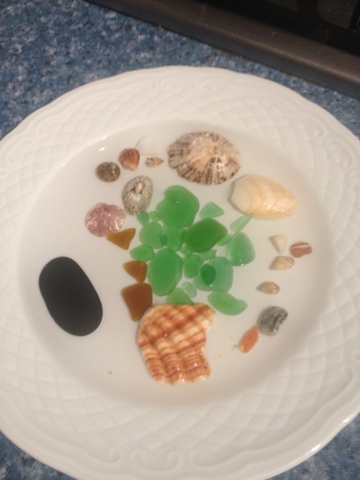
As a child, many of my happiest times were spent on the beach - often the local coast near home, or on longer trips further down the Jurassic stretch between Poole and Weymouth. Beach-combing was a favourite activity, and seems to be a past-time I can share with my daughter. Neither of us have great attention spans, but tonight we spent an hour searching for shells, pebbles, and her favourite, sea glass. Every time we forget that it doesn't look the same out of water; the bright sparkle dulls as soon as it dries out - but we still collect it.

I'm not a classic amongst mums. Patience isn't my best feature; I get bored easily - I usually have my nose in my own book, rather than hers. I have serious workaholic tendencies, and came to motherhood too late to have the energy required for endless playing (it must be said that I don't feel guilty about any of this. I'm who I am, and I do my best, as parents do).

Tonight, though, we walked along the shore, lost in the focus of our search, and happy in each other's company. I wanted to capture this, before I go back to normality and forget the feel of her small hand in mine; and the joy I felt in her excitement as she showed me her latest discovery.

I'm keeping the sea glass under water for a while too. Sometimes you need to hang on to the sparkle for a just little bit longer.

Monday, 11 May 2015

Home

You ask me where I come from
And I tell you this.

A place but not one place
Roots that exist, but struggle to grip the sand
That lined the streets I walked on

Or, less cryptically
Barrow boys and seafarers.
Dodgers of the Blitz and the Titanic bullet
East end and West quay
City and sea.

Sea!
And the island so close that the water between is an irrelevance
Jurassic cliffs and chalk horses.
Beaches in the forest
White yachts that fill my eyeline
A flight that takes me not too far out
But loops the land to return.

Friendship
And the love of an almost-sister
A symbiosis of circumstance.
Labour pains and failed expectations
Hopes dashed in the unexpected chill of a spring day.
The glory of imperfection.

Love
And most of all, the love of acceptance
Of a woman, unjudging
Who holds that child and will never let her go.

You ask me where I come from
And I tell you this.


Saturday, 14 February 2015

Love

Love.  Not a word you will generally find in education blogs, even on Valentine’s Day.  And I've hesitated before writing this one – in a world where talk is of grit, resilience, rising to the challenge – where classrooms are described as ‘battle grounds’ and teachers are told to toughen up – where’s the place for it?


Over the past few months I’ve been fortunate enough to observe many hours of teaching (47 since October, to be precise).  Welcoming an observer into your classroom is always a challenge, even when it’s just me coming in, your friendly little tutor.  I have a lot of respect for student teachers who are observed all the time by their tutors, mentors and peers – sometimes all of these in the same lesson, hanging around in anticipation, like an NHS crash team.  I always write a lot of feedback, and the word ‘love’ does not appear on any of my observation forms.  Yet despite all the pressure and artificiality of an observed teach it’s usually there, like a big (cuddly) elephant in the corner of the room, colouring and shaping the very best teaching that I’ve seen.  I would even argue that it is the key difference between good and great– its presence is vital, yet hard to define.  You’ll never put love into a tick-box.
        
By love, I mean love for teaching itself, of course.  I’ve witnessed joy and pleasure in the crafting of a lesson that works, the delight in trying something new, the satisfaction of challenging yourself, excitement at helping understanding, the sheer delight at seeing a stuck penny finally drop.

I also mean love for students (don’t smirk) – shown through the absolute acceptance and celebration of difference, the presence of empathy and kindness, values expressed through caring and the encouraging of independence.

Perhaps the hardest element here (and arguably the most important) is the love that teachers feel for themselves.  Student teachers, like us all, are their own worst critics – in shoe-horning all the essential elements into their lessons, embedding so much necessary stuff it all becomes like an overstuffed Christmas cake – with so much going on you don’t know what flavour to concentrate on first.  In the midst of all of this, encouraging students to be fully themselves, it is difficult to remember that we need to be ourselves too – in all our failings and vulnerabilities.

I owe a lot of this thinking to Nancy Kline’s ten components of a Thinking Environment - which are all about love, of course.  Paying attention, having a place that communicates to people that they ‘matter’, achieving equality of participation, moving beyond competition – at the same time the most simple, and the hardest things we can do. And my ultimate inspiration - @teachnorthern’s four cornerstones of social purpose teaching. Teaching to benefit the world - connecting with our own values as teachers - reflecting on our practice and truly embedding diversity - if these aren't all about love, I don't know what is.

I’ll leave you with this poem by Al Zolynas – and a plea not to 'keep a coward's silence' but to capture and remember those moments of love, which are ultimately, for me, what teaching is really all about.

Love in the Classroom

Afternoon. Across the garden, in Greco Hall,
someone begins playing the old piano–
a spontaneous piece, amateurish and alive,
full of a simple, joyful melody.
The music floats among us in the classroom.

I stand in front of my students
telling them about sentence fragments.
I ask them to find the ten fragments
in the twenty-one-sentence paragraph on page forty-five.
They've come from all parts
of the world–Iran, Micronesia, Africa,
Japan, China, even Los Angeles–and they're still
eager to please me. It's less than half
way through the quarter.

They bend over their books and begin.
Hamid's lips move as he follows
the tortuous labyrinth of English syntax.
Yoshie sits erect, perfect in her pale make-up,
legs crossed, quick pulse minutely
jerking her right foot. Tony
sprawls limp in his desk, relaxed
as only someone can be who's
from an island in the South Pacific.

The melody floats around and through us
in the room, broken here and there, fragmented,
re-started. It feels mideastern, but
it could be jazz, or the blues–it could be
anything from anywhere.
I sit down on my desk to wait,
and it hits me from nowhere–a sudden
sweet, almost painful love for my students.

"Nevermind," I want to cry out.
"It doesn't matter about fragments.
Finding them or not. Everything's
a fragment and everything's not a fragment.
Listen to the music, how fragmented,
how whole, how we can't separate the music
from the sun falling on its knees on all the greenness,
from this moment, how this moment
contains all the fragments of yesterday
and everything we'll ever know of tomorrow!"

Instead, I keep a coward's silence.
The music stops abruptly;
they finish their work,
and we go through the right answers,
which is to say
we separate the fragments from the whole.


Cutts, N. (2010). Love at Work, Fisher King Publishing

Kline, N. (1995). Time to Think, Cassell Illustrated

https://teachnorthern.wordpress.com/about-us/about-teachdifferent/

Sunday, 14 December 2014

Intersectionality - and a bear called Paddington


I'm lucky enough to get involved in many of @teachnorthern's fantastic projects (she couldn't bear my nagging otherwise) -  and the latest one 'TeachDifferent: Identity' looks set to be a cracker.  The project aims to explore concepts of intersectionality and diversity; moving educators away from 'tick-box' approaches to equality to considered examinations of society's, and our own limiting assumptions. Identities will be explored through coaching, community philosophy and dialogic approaches.  It will celebrate our multi-layed, glorious complexity as human beings and also encourage us to consider and challenge how identity is used to oppress.  It's a brave and exciting project that will, I think, strike at the heart of our values and beliefs as educators.

The term 'intersectionality' was first coined by Kimberle Crenshaw in a seminal article* which examines how patterns of oppression are bound together.  For example, women can face discrimination on grounds not only of their gender but also their race, class, ethnicity, ability.  Society (and law) like to categorise us into one protected characteristic or another, but rarely examines the complex space between them - where people might have many identities, and can be treated (or oppressed) differently according to the way that they intersect.

Intersectionality can't really be considered without thinking about privilege also.  As a white woman, fortunate to have lived a life full of means and opportunities, I want to recognise this and explore it more for myself.  I am gradually becoming aware of the unconscious ways in which my identity privileges me every second of every single day. (Peggy McIntosh writes powerfully about this, here). Writing this blog is, in itself, of course, an act of privilege. This thought has stopped me pressing the Publish button more than once, but I don't want my ego to stop me exploring ideas and talking about them.

Kay SidebottomTypically, I want to do EVERYTHING at once, so found myself this weekend researching identity politics in the middle of taking the kids to see Paddington at the cinema.  In my usual, non-academic way, I started to think about the small bear from Darkest Peru in terms of his own issues with connecting and managing the intersections of his identity.  

So this is what I thought about.

Paddington is a bear, of course - but he isn't just a bear.  In fact, this aspect of his identity is generally accepted without question; he appears out of the blue at a London railway station and is mostly ignored.  In the film he gets lost and Mrs Brown reports him to the police as a missing person.  'Around 3 foot 6 - blue duffle coat and a red hat - oh and he's also a bear,' she describes. 'That's not much to go on,' the police officer replies.

Paddington is also an immigrant, an exile, an outsider.  These are the issues that he most commonly explores; the facets of his identity that he most struggles with. He undertakes a quest to become 'English', whilst holding tight to the memories he holds in his red suitcase, and writing to his beloved Aunt Lucy at her Home for Retired Bears.  He struggles to adjust to life in a cold and damp London; he suffers oppression at the hands of the meddling neighbour, Mr Curry.  He is a child, although his age is never made clear.

What I love most about the book is that Paddington is different, but his most obvious difference (he's a BEAR!) is irrelevant to the story. (Children get this and completely accept it, because they haven't yet learnt that that 'different' doesn't mean good).   Paddington's 'bear' status isn't all he's about - he isn't asked to represent all bears or to speak on every bear's behalf.  The story is more interested in exploring the relationship between his identities as an exile, a child, an adopted person.  It does not attempt to over-simplify, but recognise the complexity within.

Life isn't like Paddington, of course. At the end of the film, he writes a letter to his Aunt in which he states: 'In London nobody's alike, which means everyone fits in.' We dream of a world like this, where differences are a cause of celebration, or accepted without question.  This blog also over-simplifies complex, political concepts, but I know that #TDIdentities will allow to us open up important and meaningful discussions - and give teachers the confidence to do the same in their classrooms.

*Crenshaw, K.W. (1989). Demarginalizing the intersection of race and sex: a black feminist critique of antidiscrimination doctrine, feminist theory and antiracist politics. University of Chicago Legal Forum 140:139-167


Friday, 5 September 2014

Reflective teacher - 30 day blogging challenge, day 5

Today's challenge asks you to post a picture of your classroom, and discuss what you see and don't see, that you'd like to.

I wondered about missing this one out, as I don't have my own classroom, or actually a permanent place of work - and also, these days a lot of teaching and work I do is on-line.  (I could post a picture of my office at home, but you really don't want to see that).  The same is actually true for most of the teachers I know these days; erosions of physical space due to cost-cutting, and changing work practices and patterns makes having your very own space unlikely. This made me question 'are physical classrooms that important?' but I really believe that they are; as Nancy Kline says 'Place matters because it says back to you that YOU matter.'

At the start of a new term I've noticed lots of school teachers sharing pictures of their classrooms (shared or not) on Twitter, and they really are things of beauty.  Design and intelligence about use of space and the impact on learning has moved on enormously and the rooms are bright, clean, informal and welcoming.  I would certainly feel that I mattered in places like that. The presence of light especially seems to a big impact on how people feel, and how able they are to concentrate and take in information.  The beautiful big windows in the classrooms at Northern College (usually open with the blinds up) seem to open up my mind too, and let new thoughts in.

I don't have much influence over where I teach, although I do try to reorganise the room layout whenever I can (often to people's annoyance).  During my time as a trainer at the Council, I had a sudden lightbulb moment when I realised how much an impact the spaces chosen for councillors and officers to 'learn' in actually had.  Most of the sessions were held in Committee Rooms - formal spaces, more appropriate for the cut and thrust of political meetings than relaxed discussion and group working.  People would naturally slip back into their Council roles in places like that - the physical barriers of static tables, microphones and heavy chairs also made teaching practically very difficult.  I'm not sure what those places said to us.  Not 'you matter', but 'process matters, tradition matters, the status quo matters'.  Once I realised this I did my best to find alternatives, settling finally on the Members' Lounge - a rather antiquated room with easy chairs, plush carpet and the air of an old people's home.  This room didn't particularly say ' you matter', either but it did say 'sit together; relax; talk; be comfortable.'  I would like to think that as a result of running sessions in here the quality of the thinking and discussion went up, although it isn't easy to quantify.

Although there isn't always much you can do to influence the spaces you're given, there are little things you can do (as well as rearranging the furniture) once you're in there that can help.  Getting light and air in are vital. Using posters, flipcharts, a welcome picture on the door (thank you @teachnorthern for getting me to see the importance of this), water on the tables, coloured post-its dotted around to brighten things up. Once students create their own work of course you can use this on the walls, too.

What do the places you teach in say to your students, and to you?  And what can you do to make them say 'you matter?'


Thursday, 4 September 2014

Reflective teacher - 30 day blogging challenge, day 4

Today's question is a classic - 'What do you love most about teaching?'

I've been mulling this one over and it helps me to compare what, in my mind I do now - 'teaching' with what I did a few years ago - 'training'. Training people was generally about achieving the aims of the organisation. It was great if workers enjoyed it, and grew and developed along the way, but ultimately the needs of the company had to be met. Increased productivity, fewer absences, and lower staff turnover was generally the name of the game - where I worked, anyway.

If you look at the government's agenda around the education of adults, I would suggest that these aims are broadly similar. Jobs teaching functional skills and 'employability' are everywhere, and I teach these things myself. So if I'm doing similar kind of work, why do things feel different for me now? Why do I enjoy it so much more and how come I'm more creative than I've been at any other point in my career?

The truth lies in the word 'Teacher'. Simply by calling myself this I have opened a world of possibly for myself and my students, and it is mainly about growth. Training feels limiting and functional (you 'train' a dog). In 'teaching' there is the wriggle room to do things differently, be truly inclusive, consider the individual, question things, reflect and grow, be yourself. As a teacher I allow myself the freedom to write, make connections on Twitter, continue to read (though I don't have to). Of course there will be many trainers who do all this too, and more, but I do think that we are often limited (or conversely, emancipated) by the words we select to describe and identify ourselves.  What connotations do the words you choose to use about yourself have, and are they limiting?

There is also, in teaching, a respect for self-development that I haven't found elsewhere (not shared and respected by all of course). It's about professionalism, but something more than that - especially if, like we do, you teach for a social purpose, believing that education really can change lives, communities, and the world. Importantly, this all starts with the teacher and the faith that we can be the best we can be, if we are prepared to work at it and want it enough.

My thoughts have rambled a bit here, but I think what I'm essentially trying to say is that teaching for me is believing in the capacity within every person and ourselves as teachers to grow and develop.  It's about questioning, and looking at things in new and liberating ways.  The very process of spending 20 minutes or so thinking this through and writing about it - and the pleasure I've taken from it -  sums all this up for me, in a 'meta' kind of way :)

Tuesday, 2 September 2014

The reflective teacher - 30 day blogging challenge, day 3

Today's question theme is observation - choose one area of practice that you want to improve on.

This topic is fairly fresh in my mind, having gone through an Ofsted assessment earlier this year.  There are lots of areas I want to improve on if I'm honest.  I'm a reflective person by nature (as this blog testifies) and have the tendency as teachers often do, to be self-critical.  The brilliant Stephen Brookfield's Perfect 10 theory* (about how we focus on the one negative comment in a sea of excellent feedback) is an important reminder about how we should always seek out the positives and keep a sense of perspective.  I really believe that we need to keep in mind the fact that students (particularly adults) enter the classroom with experiences, situations, worries and fears that are a natural part of life, and affect their learning.  As teachers, we can't influence everything, so it is important to maintain a realistic outlook about what we can achieve in the little time we are with them.

This being said, of course we should seek out improvements and constantly work to improve our teaching practice.  I was paralysed with fear when Ofsted came to observe me and while the inspector's comments were positive and helpful, I prefer the relaxed and informal feedback given by critical friends and colleagues. The head teacher John Tomsett (@johntomsett) asks his staff the question 'How can I observe your lesson in a way which best helps you improve your practice?'  This shifts the focus from performance management to productive and constructive feedback, giving the responsibility and ownership of development back to the teacher.  For me, the answer might be 'Can you join in with the group activity on x, as I would like to get a sense of whether the students are really learning effectively?' or 'Can you come at the start of the lesson, as I would appreciate some ideas on how better to open it?' or 'Can you read through the feedback I'm giving student x, as I would like your views on to improve my assessment methods?'   Teachers generally have a good sense of where their practice needs extra work, so why not take advantage of this and help them where they need it most?

I also think that we don't actually observe each other enough.  You can learn so much from seeing other teachers (particularly in your subject specialism). Co-teaching with a colleague provided me with so much learning this year, and one of my aims for the coming term is to do more of this. Observation shouldn't be about fear but about growth - and learning, not just for the observed, but for the observer too.

*Brookfield S, (1995) Becoming a Critically Reflective Teacher, Jossey-Bass